How to Choose the Perfect Boxing Glove Size
Size Guide
Choosing the perfect boxing glove size feels simple until you actually try to do it. Every new boxer hits the same wall—you put on one pair, and it feels too tight, another pair feels too loose, and suddenly the numbers printed on the glove (8oz, 10oz, 14oz, 16oz) mean absolutely nothing. Mostly, beginners are seen walking into a gym with gloves that are two sizes too small, with their knuckles jammed against the padding, or oversized gloves that feel like pillows strapped to their wrists. The truth is: your glove size determines your safety, comfort, technique, and long-term progress. It’s not just about buying “boxing gloves”; it’s about choosing your boxing gloves.
This guide will walk you through everything that—how glove ounces work, how to measure your hand, how training style affects glove choice, the difference between men’s, women’s, and youth sizing, and how to choose the right pair, whether you’re hitting the heavy bag at home or sparring in a real gym. By the end, you’ll know exactly what size you need and why.
Understanding Boxing Glove Sizes
What Ounces Really Mean
Boxing gloves aren’t sized like regular clothing. Instead, they’re measured in ounces (oz), and those ounces reflect the weight of the glove—not the weight of your hand. The higher the ounce, the more padding the glove contains. More padding means more protection for your hands and your training partner, which is why sparring gloves are heavier than bag gloves.
For example, an 8-oz glove is compact, light, and often used for speed or competition. A 16oz glove, on the other hand, is thicker, softer, and more protective—ideal for sparring. Glove weight also affects wrist stability, and that’s why heavier gloves often offer better wrist support, especially in brands known for their padding structure.
Understanding these differences helps you avoid the biggest mistake beginners make: choosing gloves based on weight alone without considering training purpose.
How to Measure Your Hand for Boxing Gloves
The Accurate Method
Now, let’s talk about your hand. Most people guess their glove size without ever measuring anything, which usually leads to discomfort or long-term wrist strain. The right way to size boxing gloves starts with knowing your hand circumference.
Wrap a measuring tape around the widest part of your knuckles—excluding the thumb. That number gives you a baseline for glove fit. If you’re using hand wraps—which you absolutely should—your glove size often increases slightly. Wraps add thickness, especially around the knuckles and wrist, so gloves that fit “just right” without wraps may suddenly feel tight once you start training properly.
Your goal is a snug glove that still allows a full fist, proper thumb alignment, and secure wrist closure.
Boxing Glove Size Chart for Men, Women & Youth
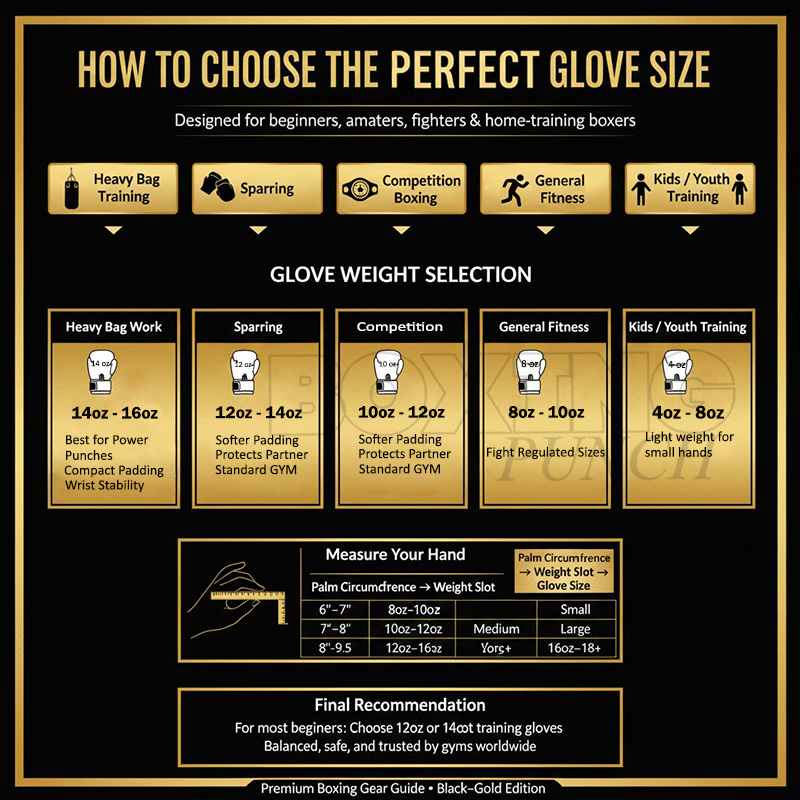
Sizing isn’t universal across brands, but this chart gives a reliable starting point. If you’re hitting the heavy bag, doing cardio boxing, or sparring, your glove size will shift slightly.
Here’s how sizes generally break down across weight ranges:
- 8oz gloves are mainly for youth fighters or adults with very small hands who are focused on speed or competition-style striking.
- 10oz gloves work well for bag work when you want more power transfer and a tighter glove silhouette.
- 12oz gloves are the “fitness boxing” favorite because they’re versatile for home training and cardio sessions.
- 14oz gloves are considered the all-purpose training glove for most adults.
- 16oz gloves remain the gold standard for sparring because of their high-density padding and increased knuckle protection.
Women typically fall within the 12-oz–14-oz range, depending on hand size. Youth boxers often use 4oz–8oz gloves depending on age and weight.
Simple Glove Size Comparison Chart
This table helps beginners instantly understand which glove size matches their weight, training style, and experience level.
| Your Weight | Bag Work | Pad Work | Sparring | General Training |
|---|---|---|---|---|
| Under 120 lbs | 8oz – 10oz | 10oz | 14oz | 12oz |
| 120–150 lbs | 10oz – 12oz | 12oz | 16oz | 12oz – 14oz |
| 150–180 lbs | 12oz | 12oz – 14oz | 16oz | 14oz |
| 180–210 lbs | 12oz – 14oz | 14oz | 16oz – 18oz | 14oz |
| 210+ lbs | 14oz | 14oz – 16oz | 18oz | 16oz |
Advanced Comparison By Skill Level & Gender
| User | Recommended Size | Reason |
|---|---|---|
| Women beginners | 12oz | Balanced padding + comfort |
| Women sparring | 14oz – 16oz | Safer for partner work |
| Men beginners | 12oz – 14oz | Ideal for home training |
| Men sparring | 16oz | Universal gym requirement |
| Kids ages 5–10 | 4oz – 6oz | Small hand compartment |
| Teens | 8oz – 10oz | Transition sizing |
| Competitors | 8oz – 10oz | Fight-weight gloves |
Choosing the Right Glove Size Based on Training Type
This is where glove sizing really becomes personalized. Different training styles demand different glove weights.
If you’re focusing on heavy bag work, you’ll want a glove that lets you feel the contact while protecting your knuckles. That’s why 10oz or 12oz gloves are often called the “best boxing gloves for heavy bag work.” They allow speed while maintaining structure.
If you’re sparring, the priority shifts toward safety. Sparring requires more padding, especially over the striking surface. That’s why 16oz gloves are the universal sparring standard across nearly all boxing gyms.
Home training sits somewhere in between. If you’re mixing bag work, cardio punching, and technique drills, a 12oz or 14oz glove may be the most comfortable choice.
Muay Thai and MMA crossover styles use gloves that are more flexible at the wrist, so sizing also depends on mobility needs. Some people prefer 14oz Thai-style gloves because of their softer feel and wider hand compartments.
| Glove Size (oz) | Primary Purpose | Typical User / Context | When / Where It’s Used |
|---|---|---|---|
| 6 oz – 8 oz | Competition / Youth Training | Youth boxers or very small adults. Professional fights (Women’s competition often 8 oz). | Official bouts. Speed & impact-focused training. Not for heavy bag or sparring. |
| 10 oz | Competition / Light Bag Work | Competitive boxers (lower weight classes), some women for training, or smaller-handed adults for fitness. | Amateur/pro fights. Also for technical bag work (focus on speed). Rarely for sparring (requires partner consent). |
| 12 oz | All-Purpose Training (Standard) | Most women and lighter/medium-weight men (under ~150 lbs). The most common first glove for general fitness. | Heavy bag, mitts, double-end bag. Not for hard sparring (inadequate protection). The default for many boxing fitness classes. |
| 14 oz | All-Purpose Training & Sparring | Average-weight men (~150-180 lbs) and larger/stronger women. Common sparring size for women and lighter men. | Bag work, mitts, and light-to-medium sparring (if both partners agree). A versatile “do-most-things” size for many. |
| 16 oz | Sparring & Heavy Training | Average-to-heavyweight men (over ~165 lbs). The universal sparring standard in most gyms. | Primarily for sparring (safety for you and your partner). Also used for heavy bag work to build endurance and shoulder strength. Gym mandatory. |
| 18 oz – 20 oz | Heavy Bag / Conditioning | Large/strong boxers (e.g., heavyweights) for conditioning, or anyone with previous hand/wrist issues. | Exclusive heavy bag work and conditioning drills. Adds extra resistance. Rarely used for sparring (excessive weight can be awkward). |
Important Note: The above is a general guide. Always prioritize your gym’s specific rules (many require 16 oz for all sparring) and your personal comfort and hand safety.
How Your Body Weight Influences Glove Size Selection
One of the most overlooked factors in glove sizing is your own weight. A 110-pound beginner throwing punches with 8oz gloves is far less risky than a 185-pound beginner punching with the same size. Heavier fighters generate more force naturally, so they need more padding for protection.
- If you weigh under 120 pounds, your glove sizes generally fall between 10oz and 12oz for bag work, and 14oz for sparring.
- If you weigh 150 pounds or more, you’ll typically prefer 12oz–14oz for training and 16oz for sparring.
Women, despite hand size differences, follow the same protection guidelines, especially if training intensity is high.
Training Scenarios and the Best Glove Size for Each
When choosing glove size based on activity, think of it like choosing a tool for a job. You wouldn’t use a sledgehammer to drive a small nail, and you wouldn’t use a mini hammer to break concrete. Gloves work the same way.
- For punching bag sessions, tighter gloves with slightly less padding (10oz–12oz) help you feel your punches and improve technique.
- For sparring, every gym prefers 16oz gloves because safety always overrides power.
- For home training mixes—shadowboxing, bag rounds, occasional partner drills—14oz gloves offer an ideal middle ground.
- For Muay Thai, brands like Fairtex or Twins tend to have a more spacious glove design that helps with clinching, so size selection follows comfort more than strict ounce guidelines.
How to Know If Boxing Gloves Fit You Perfectly
The Fit Test
Once you put gloves on, you should instantly feel whether they “belong” to your hand. A proper fit feels natural—your fist closes comfortably, your fingers aren’t crushed, and your thumb rests in its pocket without twisting. There shouldn’t be extra space inside, because that space leads to sliding, which eventually leads to wrist problems.
Close the Velcro or lace-up system and check your wrist alignment. If the glove pulls your wrist backward or sideways, it’s too loose or poorly designed. If your knuckles feel sharp pressure even with wraps, the glove is too small, or the padding is too firm for your training style.
Why the Right Fit Isn’t Just About Comfort
Think of your boxing glove less as a piece of clothing and more as a critical piece of sports equipment, like a running shoe or a bike helmet. Its primary job is protection.
A glove that’s too large will allow your hand to slide around inside. Every punch becomes a mini-collision for your knuckles and wrist, dramatically increasing the risk of sprains, fractures, and long-term issues like arthritis or “boxer’s knuckle.” It’s like driving a car with a loose steering wheel—you have no control, and it’s dangerous.
Conversely, a glove that’s too small will cramp your hand, cutting off circulation and preventing you from making a proper fist. This not only hurts but also cripples your technique and power. Your performance depends on a secure connection between your fist and the target.
The sweet spot is what we call the “Goldilocks Fit”: snug but not tight, secure but not restrictive. When you make a fist, your knuckles should gently kiss the padding in front, your fingers should be able to curl comfortably without crunching, and your wrist should feel locked in place, with zero side-to-side wiggle.
Decoding the Language of Gloves
Before we measure, we need to speak the language. Let’s break down the three key terms you’ll always see.
First, and most confusing, is ounces (oz). This does not refer to the weight of your hand or your body. It refers to the weight of the glove itself, which directly correlates to the amount of protective padding inside.
- Lower ounces (6oz, 8oz, 10oz): These are lighter, with less padding. They are often used in professional competition for speed and are suitable for very focused pad work or speed bag training, where feedback is key.
- Middle ounces (12oz, 14oz): This is the universal training sweet spot. A 14oz boxing glove is the most common, versatile choice for adults. It provides excellent protection for bag work, mitts, and general fitness training.
- Higher ounces (16oz, 18oz, 20oz): These are your sparring gloves. The extra padding is crucial for protecting both you and your training partner. Many heavier or more powerful hitters also prefer 16oz for heavy bag work for the added protection.
Next, you must understand the role of hand wraps. These are non-negotiable. They provide critical wrist stabilization and knuckle protection. When we talk about glove fit, we always mean the fit with your hand wraps on. They add noticeable volume to your hand, which is a central factor in sizing.
Finally, the closure system affects fit and support.
- Velcro (Hook & Loop): Offers great convenience and solid wrist support for 99% of trainees. It allows for easy on/off and micro-adjustments during your workout.
- Lace-Up: Provides the absolute best, custom-fit lockdown and wrist support. Preferred by professionals and serious competitors. The downside? You need a training partner to lace them up for you every time.
Your Step-by-Step Sizing Roadmap
Now, let’s get you sized. Follow these steps in order.
- Step 1: Measure Your Dominant Hand. Take a soft tailor’s measuring tape. Wrap it around the widest part of your dominant hand—across your knuckles (metacarpals), excluding your thumb. Keep your hand flat but relaxed. Note this measurement in inches or centimeters. This is your hand circumference.
- Step 2: Consult a Brand-Specific Size Chart. This is the most important step people miss. There is no universal boxing glove size. A “Large” in Everlast can be completely different from a “Large” in Cleto Reyes or Fairtex. Always, always find the official size chart for the specific brand and model you want. Match your hand circumference measurement to their chart (e.g., 8″ circumference = Size Medium). Brands like Ringside or Title often have consistent sizing, while Mexican-style gloves like Reyes tend to fit tighter.
- Step 3: The “Fist Test” – Simulating the Fit. Before you click “buy,” do this mental check. Imagine the glove on your wrapped hand. Make a fist. Your knuckles should be positioned right at the front of the padded “sweet spot.” You should be able to curl your fingers fully without them pressing hard against the end of the glove. Your thumb should have a comfortable, natural position. The fit should feel uniformly snug, like a firm handshake, not tight in one spot and loose in another.
- Step 4: Consider Your Primary Use. With your size (S, M, L) determined from the chart, now choose your ounce weight based on what you’ll do most. For all-around home training, 14oz is a perfect, safe starting point for most adult men. For sparring-focused training, lean towards 16oz. Women and younger athletes might find 12oz or 14oz more appropriate for general training.
Special Considerations and Pro Tips
A few extra pieces of wisdom from the gym:
- Between Sizes? If your measurement is on the line, size up. It’s better to have a little extra room (which hand wraps will fill) than a glove that’s too tight.
- Breaking Them In: New gloves will feel stiff. This is normal. The foam padding and leather will soften and mold to your hand shape over 5-10 training sessions. Don’t try to force it artificially.
- Women’s & Youth Gloves: Many brands now design gloves with a narrower palm and shorter finger compartments to better fit different hand proportions. If you have a slimmer hand, seek out these models.
- The Ultimate Test: If you have any chance to visit a sports store or a specialized boxing shop, do it. Trying on different brands with your wraps is the single best way to understand fit.
Materials and Construction
How Glove Build Affects Size
Real leather gloves stretch slightly over time, creating a more custom fit. Synthetic gloves rarely soften in the same way, which means your glove size needs to be more accurate from the start. Lace-up gloves offer the most customizable fit, but Velcro gloves remain the go-to for home training because of convenience.
Padding type also matters. Multi-layer foam, gel padding, horsehair blend, and hybrid materials all change how gloves feel. Brands like Winning are famous for their cloud-like padding, which makes even heavier gloves feel soft, while Mexican-style gloves like Cleto Reyes are known for a tighter hand compartment and firmer punch feedback.
Affordability & Budget
What You Really Need to Spend
Glove prices vary widely across the United States, Europe, and international markets. Affordable boxing gloves can start as low as $20–$30, but quality often improves around the $50–$90 range. Premium gloves like Winning or Grant can exceed $400, but beginners rarely need that level of investment.
If you want the best affordable boxing gloves, brands like RDX, Venum, Title, and Everlast offer budget-friendly options without sacrificing durability. The most affordable boxing gloves often use synthetic materials, but good models still provide adequate padding and wrist support for beginners.
If you’re asking how much boxing gloves cost on average, most home boxers fall comfortably in the $40–$120 range, depending on quality and purpose.
Top Glove Brands and How Their Fit Differs
Brand matters more than people realize. Every glove brand has its own “fit personality.”
Cleto Reyes is slim and compact with a “Mexican-style” puncher’s feel.
Winning is pillowy, protective, and wider in the hand compartment.
RDX and Venum tend to have more universal sizing, making them popular for beginners.
Fairtex and Twins are staples for Muay Thai, often fitting wider and softer.
Everlast varies heavily between budget and pro models, but their sizing is generally true to measurement.
Knowing these brand differences helps you choose gloves that feel natural right out of the box.
Common Mistakes Beginners Make When Choosing Glove Size
Most beginners buy gloves that are either too small or too heavy. Some choose gloves based on color or brand without considering proper sizing. Others forget about hand wraps entirely, forcing them to size up later. And many beginners buy gloves that are too cheap, only to discover that poor padding leads to knuckle pain.
Avoid these mistakes by following the measurement system, matching glove ounces to your training type, and choosing gloves that support your wrists properly.
How to Choose Your Perfect Glove Size
Final Step-by-Step Guide
Start by measuring your hand circumference.
Match that measurement with your body weight and intended training style.
Choose glove ounces based on activity—lighter for bags, heavier for sparring.
Pick a reliable brand known for consistent sizing.
Then test the fit: fist comfort, thumb alignment, wrist support.
Here are 5 Steps to Choosing Your Perfect Boxing Glove Size
Once all these pieces align, you’ve found your perfect glove size.
Conclusion — Picking the Right Boxing Glove Size Sets You Up for Success
Choosing the perfect boxing glove size isn’t guesswork. It’s a combination of understanding your hand, your training goals, your body weight, and how glove padding works. When all these elements come together, your gloves become an extension of your body—comfortable, safe, supportive, and ready for every punch you throw.
Get the right size now, and you’ll protect your hands for years of training ahead.
FAQs — Real, Practical, Beginner-Friendly
Q: What size boxing gloves should a beginner get?
A: Most beginners start with 12oz or 14oz gloves for general training, depending on body weight and hand size.
Q: What size gloves do I need for sparring?
A: Almost all gyms require 16-oz gloves for sparring to protect both fighters.
Q: Are heavier gloves better?
A: Heavier gloves offer more padding and protection, but aren’t always necessary for bag work.
Q: Do women need different glove sizes?
Women follow the same ounce guidelines but may prefer brands that design narrower hand compartments.
Q: Can kids use adult-size gloves?
A: No. Youth gloves come in 4oz–8oz sizes for a reason—smaller hands need smaller compartments.
Q: Is it okay to buy cheap boxing gloves?
A: Affordable gloves can be excellent for beginners, as long as you choose reputable brands and proper sizing.
Q: How do I know if my gloves fit correctly?
A: Your fist should close easily, your thumb should feel natural, and your wrist should feel stable.