Beginner Boxing Workout Routine at Home

Beginner Boxing Workout Routine at Home Featured Image

Beginner Boxing Workout Routine at Home

No Equipment Needed

Beginner Boxing Workout Routine at Home

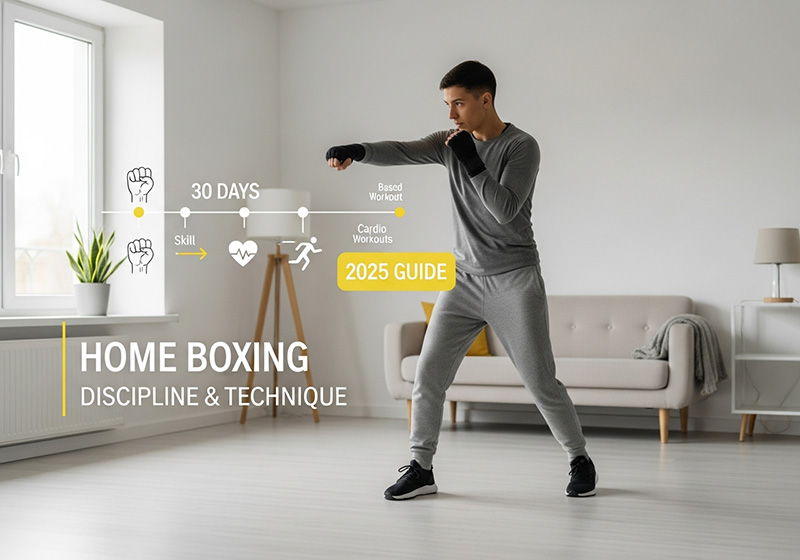
You can build a real, effective boxing foundation in your living room with just your body and discipline. This guide focuses on mindful technique over hype, providing a clear 30-day plan with skill-based and cardio workouts to boost fitness, mental clarity, and self-defense basics.

Beginner Boxing Workout Routine at Home

You don’t need a ring, a coach shouting at you, or a heavy bag hanging from your ceiling to start boxing. Right now, boxing is coming back to its roots — discipline, technique, and mental strength — not hype.

With influencer boxing everywhere and headline fights like Jake Paul vs Anthony Joshua dominating social media, more people are asking a real question: Can I actually learn boxing at home?

The answer is yes — and if you do it right, it can become one of the most powerful workouts for your body and your mind.

Let’s be honest. Scrolling through feeds of polished, hyper-energetic influencer boxing hype—the Jake Paul vs. Anthony Joshua discourse, the flashing lights of celebrity circuits—can make the idea of learning to box feel intimidating, expensive, and… loud. It feels like it belongs in a mirrored gym, not in your quiet apartment after a long day.

Forget all of that for a moment. Close your eyes and imagine something simpler. The rhythmic shhh-puh of your breath. The feeling of your weight shifting from foot to foot, light and controlled. The sharp, satisfying snap of a jab cutting through the air in front of you. This isn’t about becoming a viral sensation. This is about something much more powerful: clarity.

In a world that feels chaotic, boxing provides a profound and moving meditation. It’s you, your kinetic chain, and a simple goal: to move with purpose. And the beautiful part? You don’t need a single piece of equipment to start. This is your guide to the ultimate beginner boxing workout at home—a 2025 approach that values healing and discipline over hype.

Boxing is a Healing Approach

The conversation is shifting. After the spectacle of late 2024 and 2025, people are searching for substance again. They’re typing in “boxing for stress relief” and “boxing as therapy” more than “how to knock someone out.” They want the mental health benefits of boxing: the cathartic release of hitting a heavy bag (or the air), the intense focus that shuts off anxiety, and the discipline that bleeds into other parts of life.

Boxing is Healing (The 2025 Mindset Approach)

This is “cozy cardio” boxing at its best. You can do this in comfortable clothes, in your own space, at your own pace. It’s a mindful practice that happens to burn 600+ calories an hour. And while tech like VR boxing (think Supernatural or Fight Camp VR) can add a fun, gamified fitness layer, the core has always been—and will always be—your own two hands, your feet on the ground, and your will to learn.

Boxing is Healing, 2025 Mindset Approach

Phase 1: Essentials Before You Throw a Punch Your Foundation – Stance, Guard, and the ABCs of Movement

Before you work out, do combos, calorie burn, boxing starts, or throw a single punch, you must learn how to stand and move. This isn’t just posture; it’s your fortress and your Launchpad.

Beginner Boxing Stance and Footwork (Orthodox vs. Southpaw)

Your stance is your foundation. Think of it like the roots of a tree. Weak roots, weak punch. Most people are right-handed and fight Orthodox (left foot forward, right foot back). If you’re left-handed, you might be a natural Southpaw (right foot forward), neither is better; balance is what matters. Here’s a simple test: stand relaxed, have a friend gently push you from behind. The foot you step forward with to catch your balance is likely your lead foot.

Now, get into your “fighting chair.” Don’t stand upright. Imagine sitting back slightly into a shallow stool. Knees soft, feet shoulder-width apart. This is your center of gravity—low, centered, and balanced. You should be able to glide, not topple.

“Good footwork keeps your power connected and your body safe.”

Beginner Boxing Stance and Footwork (Orthodox vs. Southpaw)

The Impervious High Guard vs Philly Shell

Your hands are not by your waist. They’re up, protecting your face. For beginners, stick to a high guard. Think of it as your phone case: always on, always protecting the valuable stuff (your chin, or “the button”). Your gloves (or fists) should be by your temples, with your elbows tucked in to shield your body. Eyes peek over the gloves. You’re now a hard target to hit. The Philly Shell looks cool, but demands experience. High guard builds habits that protect you in the long term.

The Impervious High Guard vs Philly Shell Image

Boxing Footwork for Beginners

Great boxing happens with the feet. You don’t walk; you step-drag. To move forward, step with your lead foot, then drag your rear foot the same distance. To move back, step back with your rear foot, then drag your lead foot. Stay in your “fighting chair” the whole time. Practice this shadow step drill—forward, back, left, right—until it feels silent and smooth. This movement in the sagittal plane (forward/back) is your first language.

Boxing Footwork Guide for Beginners

Phase 2: The 6-Punch System – Your Vocabulary of Power

Think of these six punches as your alphabet. We’ll build words (combinations) later. First, master the letters.

(The ABCs of Boxing)

Punching isn’t arm work — it’s full-body movement powered by the kinetic chain.

Energy starts from the ground, travels through your legs, hips, core, shoulders, and finally snaps out of your fist. Your posterior chain and rotational core strength do more work than your arms ever will.

Here’s the beginner system:

  1. The jab (1) teaches timing and balance.
  2. The cross (2) introduces hip rotation and weight transfer.
  3. The lead hook (3) adds pivot and rotation.
  4. The rear hook (4) builds power coordination.
  5. The uppercuts (5 and 6) teach vertical force.

The famous 1-2-3-4 punch combo (jab, cross, lead hook, rear hook) is the perfect beginner flow — smooth, rhythmic, and powerful.

  1. The Jab (Punch #1): Your lead hand shot. It’s a flick, not a hammer. Snap it straight out from your guard, rotate your fist so palm lands down, and snap it straight back. It’s a rangefinder, a distraction, your most used tool. Visualize touching a hot stove—quick and precise.
  2. The Cross (Punch #2): Your rear hand power shot. This is where you feel the kinetic chain. Push off your back foot, rotate your hip and shoulder forward, and drive your right fist straight through the target. Your left hand (jab hand) stays glued to your cheek in guard. It’s a powerful door-slamming motion, driven by your posterior chain.
  3. & 4. The Hooks (Punches #3 & 4): A horizontal shot from either hand. The power comes from the pivot. For a left hook, keep your elbow at 90 degrees, pivot your left foot and knee inward, and rotate your entire torso—don’t just swing your arm. Imagine you’re turning a big steering wheel. It’s for hitting the side of the head or body.
  4. & 6. The Uppercuts (Punches #5 & 6): The rising shot. Drop that hand’s shoulder slightly, bend your knees, and drive upward as you straighten your legs and rotate your core. Your fist should travel in a vertical “U” shape. This is a prime mover for rotational core strength.

The 6-Punch System - Your Vocabulary of Power Guide

A Critical Safety Note: Make a proper fist. Thumb on the outside of your fingers, not inside. On impact, you want your first two knuckles (index and middle) to connect. To build start-up strength in your wrist and prevent injury, practice isometric punch holds: extend your punch and hold it firmly for 20 seconds, focusing on a rigid wrist.

A 30-Day Home Boxing Plan

This isn’t about random workouts. It’s a progressive skill-building journey. Do three sessions per week (e.g., Mon, Wed, Fri), with rest or light activity in between.

WeekFocusKey DrillsSample Workout
1 & 2The Technique TunnelStance, Guard, Step-Drag, Jab, Cross15-Minute Skill Builder: 3 rounds of shadowboxing, focusing only on 1-2s and movement.
3 & 4Building the ArsenalAdding Hooks, Basic Slips, 1-2-3 ComboMix 15-Minute Skill Builder with the 20-Minute “Fight Night” HIIT. Add isometric holds.

Two Key Workouts

Workout A:

15-Minute Boxing HIIT Workout at Home for Beginners 

This is a no-equipment boxing workout at home, perfect for beginners.

Warm-up (3 mins): Start with a warm-up. Mimic jumping rope, even without a rope. Light on your feet, arms relaxed. Add Arm circles, torso twists, high knees, “shadow rope” jumps (mimic jump rope).

Now the Rounds.

Round 1 – Jab & Cross (3 mins): In round one, throw the jab and cross slowly. Focus on balance and breathing. Speed doesn’t matter yet. 45 seconds of throwing crisp 1-2s in rhythm. 15 seconds of active rest (footwork).

Round 2 – Footwork & Defense (3 mins): Round two introduces defense. Practice slipping your head just outside an imaginary punch. Compare parry vs slip — parries redirect, slips move you away. Both matter. Practice step-drags, and then add simple head slips (moving your head offline).

Round 3 – Power & Combos (3 mins): Round three adds hooks. Pivot your foot as you rotate, letting your hips do the work. Imagine touching a hot stove — snap the punch and bring it back fast. Practice your hook, and then string it together: Jab-Cross-Lead Hook (1-2-3).

Cool-down (3 mins): Static stretching for shoulders, chest, and legs.

“This 15-minute boxing HIIT for beginners burns calories quietly but efficiently.”

Workout B:

The 20-Minute Fight Night Boxing HIIT Workout Style at Home (Conditioning Focus)

This is where things feel real.

The 20-minute fight night workout blends cardio boxing and intensity. Three-minute rounds, one-minute rest.

One round focuses on jab-cross speed.
Another on power hooks.
The last round finishes with The 100 Punch Challenge, a viral finisher that leaves your arms burning and lungs working.

If you’re wondering, is 20 minutes of boxing enough cardio? — Yes. When intensity is right, it rivals sprint intervals.

  • Warm-up (3 mins):(Same as above, but brisker).
  • Round 1-5 (3 mins each): The “Fight Night” Format. 2 minutes 30 seconds of work, 30 seconds rest.
    • Rd 1:Constant 1-2s.
    • Rd 2:1-2s with footwork.
    • Rd 3:1-2-3 combos.
    • Rd 4:Freestyle shadowboxing.
    • Rd 5:The 100 Punch Challenge. Throw 100 punches as fast as you can with good form.
  • Cool-down (2 mins): Deep breathing and stretching.

This is where you’ll see serious cardio boxing benefits and results for weight loss.

Two Key Workout at Home Guide for Beginners

Shadowboxing vs. Heavy Bag Work for Beginners

Shadow boxing for beginners with no equipment is the safest and smartest start. As a beginner, this is your most important exercise. It’s where you build muscle memory, technique, coordination, rhythm, confidence, and conditioning without any bad habits a bag can teach (like pushing your punches). It’s the ultimate no-equipment boxing workout at home.

So, can you learn boxing at home without a bag? Absolutely. In fact, it’s preferred for the first few months. If you crave resistance, shadow boxing with light resistance bands is a phenomenal heavy bag alternative for home that builds speed-strength.

A heavy bag workout for beginners adds resistance, but it’s not required. A pillow, resistance bands, or even slow-motion shadowboxing can act as a heavy bag alternative for the home.

So yes, you can learn boxing at home without a bag.

Shadowboxing vs. Heavy Bag Work Guide for Beginners

Common Beginner Mistakes

(How to Fix Them Today)

Dropping your hands exposes your chin. Fix it by slowing down. Holding your breath kills endurance. Exhale sharply with each punch. Worried about how to throw a punch without hurting your wrist? Keep your wrist straight, fist aligned, and punches relaxed until impact.

  1. Dropping the Hands: You throw a punch, and your other hand drifts down—the Fix: The “Chin Check” drill. After every punch, consciously touch your guarding hand to your chin.
  2. Holding the Breath: You turn purple, throwing combos. The Fix: Breathe out sharply on every punch. Make it audible: “shhh” on the jab, “PUH” on the cross.
  3. “Arm Punching”: Your punches have no power because they start at the shoulder. The Fix: Slow down. Before you throw, feel your back foot push into the floor. Let that initiate the movement.
  4. Flat-Footed Stance: You’re rooted, unable to move. The Fix: Consciously keep a slight, athletic bounce in your knees. You should feel ready to spring in any direction.

A Guide to Common Beginner Mistakes and How to Fix Them

Boxing for Weight Loss, Stress Relief & Mental Health

Boxing delivers real results for weight loss at home because it combines cardio, strength, and coordination.

A shadow boxing workout for belly fat works because rotation burns calories deeply. But beyond fat loss, boxing is therapy.

Punching stress out of your system, breathing through tension — this is why boxing is now seen as healing, not hype.

Boxing for Weight Loss, Stress Relief & Mental Health Guide

Training Like a Pro at Home

Modern Tools

Today’s home boxing world includes gamified fitness.

Apps like Fight Camp and VR platforms like Supernatural turn workouts into experiences. Smart gloves track output. This is training like a pro at home, even in comfortable clothing.

Boxing has become cozy cardio — intense but accessible.

Training Like a Pro at Home Boxing Modern Tools Guide

FAQ’s

Your Home Boxing Questions, Solved

Q: Can beginners really do a boxing workout at home?
A: Yes. Shadowboxing and footwork build real skills safely.

Q: Is shadowboxing effective for beginners?
A: Absolutely. It improves coordination, cardio, and technique.

Q: Do I need equipment for home boxing?
A: No. Gloves help later, but beginners can start bare-handed.

Q: Can boxing help mental health?
A: Yes. Boxing improves focus, stress relief, and emotional regulation.

Q: Is 20 minutes of boxing enough cardio?
A: Yes, if it’s high-intensity interval training (HIIT) like the 20-minute boxing HIIT at home outlined above. The intense work-rest cycles are incredibly efficient for burning fat and improving cardiovascular health.

Q: How do I throw a punch without hurting my wrist?
A: First, master the proper fist and focus on landing with your first two knuckles. Second, build start-up strength with isometric punch holds and slow-motion shadowboxing. Never fully lock out your elbow on impact; keep a micro-bend.

Q: What is the 1-2-3-4 punch combo?
A: It’s Jab (1), Cross (2), Lead Hook (3), Rear Hook (4). It’s a classic, powerful combination. Master the 1-2-3 first before adding the fourth punch.

Q: Can I build muscle with a no-equipment boxing workout at home?
A: You can build significant muscular endurance and tone, particularly in the shoulders, core, and back. For maximal hypertrophy (size), you’d need resistance training. However, the rotational core strength and shoulder definition from boxing are real and noticeable.

Q: What are the mental health benefits of boxing?
A: It’s a powerful stress reliever, requiring intense focus that acts as a moving meditation. It builds discipline, confidence, and provides a healthy, physical outlet for frustration. The rhythmic, repetitive nature is proven to reduce anxiety.

Conclusion—Your Journey Starts with a Single Jab

A beginner boxing workout routine at home isn’t about pretending to be a fighter. It’s about movement, discipline, and confidence.

With no equipment, no gym, and just 15–20 minutes a day, boxing can reshape your body and calm your mind. Start slow. Stay consistent. Let the punches teach you.

“Boxing doesn’t just train your body — it trains who you are.”

You came here looking for a beginner boxing workout routine at home. What you now have is a system—a philosophy of mindful movement, a clear 30-day path, and the foundational skills of the sweet science. This isn’t about becoming a pro overnight. It’s about claiming 15-20 minutes for yourself, where the only goal is to move better than you did yesterday.

The ring isn’t a place; it’s a state of mind you can find anywhere. Lace up your imaginary gloves, find your stance, and throw that first jab. Listen for the snap of your shirt. Feel your feet connect to the floor. This is your start.

Ready to put it all together? [Download your free “Beginner’s Punch Combination Progression Cheat Sheet” here], a visual guide to take you from your first 1-2 to your first fluid combinations.

How to Choose the Perfect Boxing Glove Size

Choosing the perfect boxing glove size feels simple until you actually try to do it. Every new boxer hits the same wall—you put on one pair, and it feels too tight, another pair feels too loose, and suddenly the numbers printed on the glove (8oz, 10oz, 14oz, 16oz) mean absolutely nothing.>>>>>

Leave a Reply

Your email address will not be published. Required fields are marked *

Search

Recent Posts

Plyometrics for Boxing Science vs Myths

Plyometrics for Boxing Science vs Myths Plyometrics aren’t about jumping higher — they’re about firing muscles faster. Boxing relies heavily...