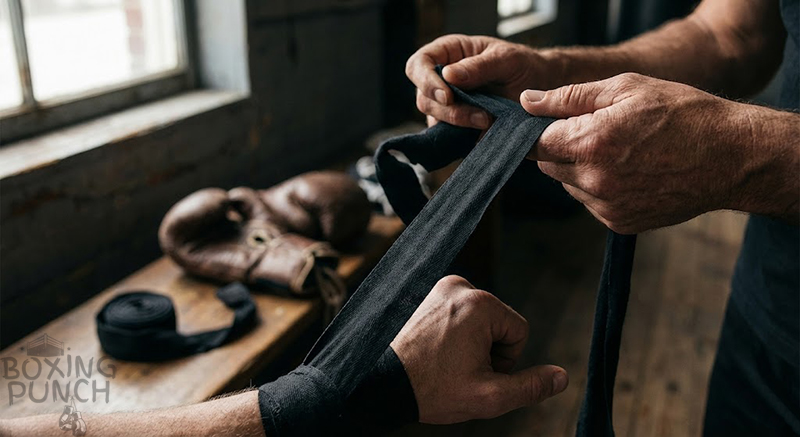
How to Wrap Your Hands Properly for Boxing A Step-by-Step Guide Walk into any boxing gym from Philadelphia to Mexico City, and you’ll see the same ritual. Before a glove ever touches a heavy bag, before the timer dings, and before a single drop of sweat hits the canvas, the fighter sits down. They unroll a spool of fabric and begin the process. This isn’t just about safety; it’s a meditation. It’s the moment you transition from a regular person into a fighter. The first time you walk into boxing, wrapping your hands feels optional. You see experienced fighters doing it quickly, almost casually, and you think gloves alone are enough. They’re not. Hand wraps are your first line of defense. They protect your knuckles, stabilize your wrist, and quietly prevent injuries that can end training before it really begins. Learning how to wrap your hands properly for boxing isn’t just a beginner skill—it’s a lifelong habit. If you are reading this, you probably just bought your first pair of 180-inch wraps, or maybe you’ve been relying on those slip-on gel wraps and realized they just aren’t giving you the wrist stability you need. You are in the right place. Wrapping your hands is an art form, and mastering it is the single most important thing you can do to prolong your boxing journey. Let’s dive deep into how to wrap your hands properly for boxing, turning your loose, fragile hand bones into a solid, heavy cast ready for impact. Why We Wrap Our Hands in Boxing Your hands weren’t designed to repeatedly smash into hard objects. Inside your fist are small bones called metacarpals, and when they’re unprotected, they’re vulnerable to one of the most common injuries in boxing. These bones are surprisingly easy to break with improper impact, leading to the infamous Boxer’s Fracture. The goal of the hand wrap isn’t just to provide a cushion for your knuckles—that’s what the glove is for. The wrap intends to bind all those tiny bones together so that when you strike, the shock distributes evenly across your arm rather than shattering a single knuckle. We are essentially building a temporary cast. Wrapping creates a protective cushion around the knuckles and keeps the bones aligned. It also adds essential wrist support, especially during heavy bag work, where impact forces travel back into the joint. Good wraps absorb shock, distribute pressure, and keep your hand functioning as one solid unit instead of loose parts. Think of wraps like seatbelts. You may not notice them when things go right, but when something goes wrong, they save you. Choosing the Right Hand Wraps for Boxing Before you can build, you need the right materials. Walk into any store, and you’ll be faced with a wall of options. Let’s break it down. For beginners, choosing wraps can feel confusing, but it doesn’t need to be. Most boxing hand wraps for beginners come in two sizes: 120-inch and 180-inch wraps. If you have smaller hands, shorter fingers, or are a youth or female boxer, 120 inches often works well. Most adults prefer 180-inch wraps because they allow better wrist support and knuckle padding. Before we start twisting fabric, we need to make sure you’re holding the right tools. Not all wraps are created equal. Mexican Style Wraps vs. Cotton Wraps This is one of the most important choices. If you ask any expert perspective, they will point you toward Mexican Style Wraps. Mexican-style hand wraps are made from elasticated or semi-stretch fabric. They mold to your hand, feel snug, and are the current trending wrap type for serious training. Cotton wraps are non-stretch and feel stiffer, but can lack comfort. Mexican vs cotton isn’t about right or wrong—it’s about feel. Most boxers eventually prefer Mexican-style wraps because they move with the hand rather than against it. Note: Traditional Cotton Wraps are non-stretch. They’re breathable, classic, and forgiving for beginners because you can’t over-compress as easily. The downside is they can loosen and “break in” during a long session, requiring a re-tightening. 120-inch vs. 180-inch Wraps Unless you are wrapping hand wraps for small hands (like for a child or a very petite youth), always go for the 180-inch wraps. The standard 120-inch ones (often sold in department stores) are simply too short to weave between the fingers and create proper knuckle padding. You need that extra length to create the X-Pattern that locks the hand bones together. Quick-Wraps vs Traditional Wraps Quick-wraps, gel wraps, and glove-style wraps are popular among home fitness enthusiasts because they save time. They slide on quickly and feel convenient. Traditional wraps offer superior customized protection. Quick wraps don’t provide the same metacarpal alignment or wrist lock. From an expert perspective, gel wraps are fine for light workouts, but traditional wraps win for safety, especially during heavy bag sessions. However, for serious heavy bag work or sparring, nothing beats a traditional wrap. Quick wraps don’t secure the wrist joint nearly as well as a manually tightened cloth wrap. Anatomy of a Boxing Hand Wrap Every wrap has key parts. The thumb loop is the starter. It initiates the wrap and sets alignment. The anchor wraps around the wrist, creating stability and joint support. The knuckle zone builds padding and cushion. The hook-and-loop closure, also called the Velcro end, locks everything in place. Understanding these parts helps you wrap with intention, not guesswork. Think of them as training wheels—useful to start, but not for the full journey. The Learning Curve What to Expect Mastering the wrap takes time. It’s a skill, just like the jab. Day 1: You will likely mess up. The wrap will bunch up in your palm, or you’ll wrap the wrong way, and the Velcro won’t align. That’s normal. Week 1: You’ll start getting the tension right. You won’t have to restart three times. Month 1: You’ll be able to do this while talking to your coach, barely looking at your hands. It becomes muscle memory. The 7-Step
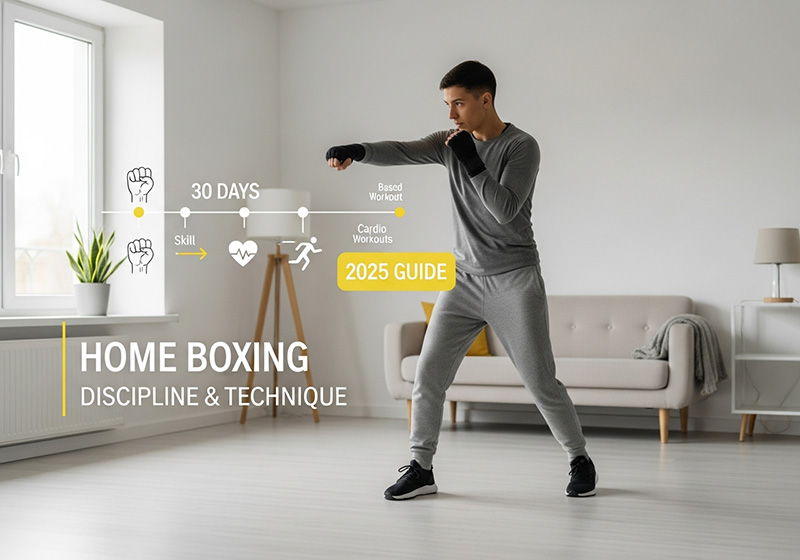
No Equipment Needed Beginner Boxing Workout Routine at Home You can build a real, effective boxing foundation in your living room with just your body and discipline. This guide focuses on mindful technique over hype, providing a clear 30-day plan with skill-based and cardio workouts to boost fitness, mental clarity, and self-defense basics. You don’t need a ring, a coach shouting at you, or a heavy bag hanging from your ceiling to start boxing. Right now, boxing is coming back to its roots — discipline, technique, and mental strength — not hype. With influencer boxing everywhere and headline fights like Jake Paul vs Anthony Joshua dominating social media, more people are asking a real question: Can I actually learn boxing at home? The answer is yes — and if you do it right, it can become one of the most powerful workouts for your body and your mind. Let’s be honest. Scrolling through feeds of polished, hyper-energetic influencer boxing hype—the Jake Paul vs. Anthony Joshua discourse, the flashing lights of celebrity circuits—can make the idea of learning to box feel intimidating, expensive, and… loud. It feels like it belongs in a mirrored gym, not in your quiet apartment after a long day. Forget all of that for a moment. Close your eyes and imagine something simpler. The rhythmic shhh-puh of your breath. The feeling of your weight shifting from foot to foot, light and controlled. The sharp, satisfying snap of a jab cutting through the air in front of you. This isn’t about becoming a viral sensation. This is about something much more powerful: clarity. In a world that feels chaotic, boxing provides a profound and moving meditation. It’s you, your kinetic chain, and a simple goal: to move with purpose. And the beautiful part? You don’t need a single piece of equipment to start. This is your guide to the ultimate beginner boxing workout at home—a 2025 approach that values healing and discipline over hype. Boxing is a Healing Approach The conversation is shifting. After the spectacle of late 2024 and 2025, people are searching for substance again. They’re typing in “boxing for stress relief” and “boxing as therapy” more than “how to knock someone out.” They want the mental health benefits of boxing: the cathartic release of hitting a heavy bag (or the air), the intense focus that shuts off anxiety, and the discipline that bleeds into other parts of life. This is “cozy cardio” boxing at its best. You can do this in comfortable clothes, in your own space, at your own pace. It’s a mindful practice that happens to burn 600+ calories an hour. And while tech like VR boxing (think Supernatural or Fight Camp VR) can add a fun, gamified fitness layer, the core has always been—and will always be—your own two hands, your feet on the ground, and your will to learn. Phase 1: Essentials Before You Throw a Punch Your Foundation – Stance, Guard, and the ABCs of Movement Before you work out, do combos, calorie burn, boxing starts, or throw a single punch, you must learn how to stand and move. This isn’t just posture; it’s your fortress and your Launchpad. Beginner Boxing Stance and Footwork (Orthodox vs. Southpaw) Your stance is your foundation. Think of it like the roots of a tree. Weak roots, weak punch. Most people are right-handed and fight Orthodox (left foot forward, right foot back). If you’re left-handed, you might be a natural Southpaw (right foot forward), neither is better; balance is what matters. Here’s a simple test: stand relaxed, have a friend gently push you from behind. The foot you step forward with to catch your balance is likely your lead foot. Now, get into your “fighting chair.” Don’t stand upright. Imagine sitting back slightly into a shallow stool. Knees soft, feet shoulder-width apart. This is your center of gravity—low, centered, and balanced. You should be able to glide, not topple. “Good footwork keeps your power connected and your body safe.” The Impervious High Guard vs Philly Shell Your hands are not by your waist. They’re up, protecting your face. For beginners, stick to a high guard. Think of it as your phone case: always on, always protecting the valuable stuff (your chin, or “the button”). Your gloves (or fists) should be by your temples, with your elbows tucked in to shield your body. Eyes peek over the gloves. You’re now a hard target to hit. The Philly Shell looks cool, but demands experience. High guard builds habits that protect you in the long term. Boxing Footwork for Beginners Great boxing happens with the feet. You don’t walk; you step-drag. To move forward, step with your lead foot, then drag your rear foot the same distance. To move back, step back with your rear foot, then drag your lead foot. Stay in your “fighting chair” the whole time. Practice this shadow step drill—forward, back, left, right—until it feels silent and smooth. This movement in the sagittal plane (forward/back) is your first language. Phase 2: The 6-Punch System – Your Vocabulary of Power Think of these six punches as your alphabet. We’ll build words (combinations) later. First, master the letters. (The ABCs of Boxing) Punching isn’t arm work — it’s full-body movement powered by the kinetic chain. Energy starts from the ground, travels through your legs, hips, core, shoulders, and finally snaps out of your fist. Your posterior chain and rotational core strength do more work than your arms ever will. Here’s the beginner system: The jab (1) teaches timing and balance. The cross (2) introduces hip rotation and weight transfer. The lead hook (3) adds pivot and rotation. The rear hook (4) builds power coordination. The uppercuts (5 and 6) teach vertical force. The famous 1-2-3-4 punch combo (jab, cross, lead hook, rear hook) is the perfect beginner flow — smooth, rhythmic, and powerful. The Jab (Punch #1): Your lead hand shot. It’s a flick, not a hammer. Snap it straight out from your guard, rotate your fist so palm lands down, and snap it straight back. It’s a rangefinder, a distraction, your most used tool. Visualize touching a hot stove—quick and precise. The
Boxing Strength and Conditioning Program for Beginners Beginners often chase fatigue instead of results. A smart boxing conditioning program focuses on: Movement quality Explosive intent Recovery Strength training supports punching power only when paired with speed, coordination, and technical boxing work. Lifting without boxing makes you strong — not dangerous. 👉 How to Improve Punching Power in 30 Days
Why Fighters Swear by Them Landmine Punch Exercises Landmine punches train power safely. Unlike free weights, the landmine allows resistance through rotation while protecting the shoulder and wrist. This makes it ideal for building power without joint overload. It strengthens the posterior chain, core, and shoulder stabilizers simultaneously—exactly what punching requires. 👉 How to Improve Punching Power in 30 Days
Plyometrics for Boxing Science vs Myths Plyometrics aren’t about jumping higher — they’re about firing muscles faster. Boxing relies heavily on the stretch-shortening cycle (SSC). Plyometric push-ups, medicine ball throws, and squat jumps teach your body to store and release energy explosively. The myth is doing more reps equals more power. In reality, quality and intent matter more than volume. 👉 How to Improve Punching Power in 30 Days
How Wrist Support Prevents Power Loss in Boxing A stable wrist acts as a solid nozzle on a high-pressure hose, directing all the force from your legs and core straight into your target. If your wrist bends on impact, that energy “leaks” back into your joint instead of being delivered, robbing you of knockout power and inviting injury. The fix is a combination of proper hand-wrapping technique, smart glove choice, and dedicated wrist strengthening. I remember the first time I truly felt it. I’d spent months building my legs, my core, my rotation. I threw a cross at the heavy bag with everything I had. I felt the drive from my back foot, the whip of my hip, the surge of power… and then, a faint but unmistakable give. It wasn’t in the bag. It was in my wrist. A microsecond of collapse, followed by a dull ache that lingered. The bag swung, but it didn’t jump. The sound was a muffled thud, not the sharp crack I was chasing. In that moment, I realized I hadn’t just felt a twinge of pain—I’d felt my knockout power leaking out of my body. You can have the strongest legs, the fastest hips, and the most explosive shoulders in the world. But if the final link in the chain—your wrist—is weak, you’re pouring your championship-level power into a broken pipe. Let’s fix that leak for good. Most fighters blame weak arms when their punches lack impact. The real problem is usually the wrist. When the wrist bends on contact, force leaks out. Instead of transferring energy forward, your punch collapses inward. Proper wrist support keeps the fist aligned with the forearm, allowing rotational torque to pass cleanly through the punch. Wrist stability also reduces micro-adjustments in the nervous system. When your brain trusts your joints, it allows you to punch harder without hesitation. The Physics of a Power Leak Your Wrist as the Weakest Link Think of your kinetic chain—that beautiful sequence from feet to hips to shoulder to fist—as a high-pressure fire hose. Your legs are the pump, your core is the engine, and your shoulder is the valve. All that pressurized water (your power) is surging forward, ready to blast. Your wrist? It’s the nozzle. If that nozzle is solid, locked on target, all that force shoots out in a concentrated, devastating stream. But if the nozzle is kinked, flimsy, or pointed slightly off? The water sprays everywhere uselessly. The pressure is lost. That’s your energy leak. Force Transmission and Newton’s Third Law This isn’t just a metaphor; it’s basic physics (Newton’s Third Law). When your fist strikes an object, that object strikes back with equal force. The purpose of your entire body’s structure is to withstand that reaction force and deliver it through the target. Here’s the critical part: A stable wrist transmits force. A collapsing wrist absorbs it. When your wrist is locked in perfect wrist alignment for boxing power, it creates a rigid, straight line from your forearm to your knuckles. This allows the shockwave of energy from your body to travel unimpeded. You deliver what physicists call your Effective Mass—essentially, your entire body weight behind the punch. But if there’s any bend—even a few degrees—on impact, that reaction force gets diverted. It’s spent on deforming your joint, stretching your ligaments, and compressing your carpal and metacarpal bones in ways they shouldn’t. The energy doesn’t go into your opponent; it reverberates back into your own anatomy. That’s power lost due to poor joint stability. The Anatomy of an “Energy Leak” This leak isn’t silent. It has symptoms: The Feeling: That subtle “give” or buckle. The Sound: A deep, dull thud instead of a crisp snap. The snap is the sound of efficient force transmission; the thud is the sound of energy being dissipated inside your glove. The Aftermath: That lingering ache in the back of your hand or your pinky knuckle, a warning sign of insufficient metacarpal protection. Your mission is to turn your wrist from a shock absorber into a steel beam. Building the Artificial Wrist Fortress Your Gear Before your bones and tendons get strong enough on their own, you use gear to build an external fortress. This is a two-part system: the wrap (the foundation) and the glove (the exoskeleton). How to Wrap Hands for Heavy Hitters The Foundation Wrapping isn’t about comfort. It’s about creating a single, unified structure. You’re not wrapping a hand; you’re casting a weapon. The goal is maximum stability. The most effective technique is often called The “Cast” Method. You’re using the wrap to lock your wrist in a neutral, straight position—the optimal alignment for power. Every pass of the wrap around your wrist and through your thumb web should have intention. Pro-Tip: Many elite fighters prefer Mexican-style hand wraps. They have a stretchy, elastic quality that allows for a tighter, more compact, and supportive wrap compared to traditional standard cotton wraps. This creates incredible internal density, fusing your hand into a solid block. Searching for “Canelo wrap style” will give you a masterclass in this approach for heavy hitters. Choosing the Best Boxing Gloves for Wrist Support The Exoskeleton The glove is your final layer of architecture. Here’s the crucial point: Wrist support is about the closure system, not the weight. A poorly designed 16-oz glove can offer less support than a well-designed 10-oz glove. The eternal debate: Lace-up vs. Velcro gloves for wrist support. Lace-ups are the gold standard. They provide a fully customizable, snug fit that molds to your wrapped hand, offering a true “cast-like” feel. The downside? You need a partner to tie them. Velcro (Hook & Loop)is about convenience and self-sufficiency. But not all Velcro is equal. In 2025, look for gloves with engineered support systems that mimic the lock of laces. This is where specific gear shines. Brands have innovated wildly: Hayabusa T3gloves feature their Dual-X wrist splinting system, with a crossed strap design that eliminates wrist flexion. Rival RS1gloves utilize their Wrist-Lock 2 system, a multi-strap design that locks your wrist in place. These aren’t just straps; they are external ligaments. When discussing the pinnacle of protection, conversations often turn to brands like Winning vs. Grant. Winning
How to Improve Punching Power in 30 Days Punching power isn’t about having big arms—it’s about using your whole body as one connected weapon. To significantly boost your punching power in 30 days, focus on mastering the kinetic chain—generating force from the ground up through your hips and core—while training for explosive speed, not just raw strength. Follow this phased, science-backed plan that prioritizes neural adaptation, Rate of Force Development (RFD), and perfect technique. Power isn’t Strength — it’s Timing Let me tell you a secret I learned the hard way. Years ago, I thought a powerful punch came from big arms and an angry chest. I’d spend hours bench pressing, curling, and pounding the heavy bag until my shoulders screamed. My punches were strong, sure, but they were slow. They pushed my opponent. They didn’t snap through him. Then, a coach watched me shadowbox for 30 seconds. “You’re all arm,” he said. “Stop trying to punch him. Start trying to punch through the wall behind him.” That single cue changed everything. It wasn’t about muscle; it was about physics. It was about becoming a whip, not a hammer. True, fight-ending power isn’t grown in a gym over years—it’s unlocked in your nervous system in weeks. This 30-day guide is key. We’re not building new muscles; we’re teaching your entire body to work as one violent, coordinated unit. You’ll learn to punch with your feet. Sounds weird? Let’s break down the science. That’s when I learned a hard truth: knockout power is physics, not muscle. If you’ve ever asked: How to increase punching power fast Why do my punches feel pushy How to punch harder in 30 days You’re in the right place. This guide breaks punching power into three clear phases over 30 days, using real boxing science, not gym myths. The Physics of Knockout Power Understanding the Kinetic Chain & Effective Mass The Kinetic Chain is the beautiful, brutal sequence that makes a punch powerful. Imagine flicking a towel to snap it. The force starts in your wrist, travels through the towel, and cracks at the tip. Your body is that towel. Understanding the Kinetic Chain & Effective Mass The kinetic chain means every punch starts from the ground, travels through your legs, hips, core, shoulders, and finally your fist. Think of it like cracking a whip: The handle moves first The tip moves fastest Your fist is the tip. Effective Mass isn’t how heavy you are—it’s how much of your body weight you transfer into the punch at impact. Fighters with great technique turn their whole body into one moving mass. That’s why relaxed punches hit harder than tense ones. Tension breaks the chain. It’s Not in the Arms Close your eyes and picture a wrecking ball. The power isn’t in the iron ball itself, is it? It’s in the massive chain, the swing, the momentum. Your fist is that iron ball. Your body is the chain, the crane, and the operator. A knockout punch follows the same principle: Initiation (The Feet): You push down and away from the ground. Load (The Hips & Core): That force travels up your legs, torquing your hips and torso like a coiled spring (Rotational Torque). Delivery (The Arm): Your relaxed arm whips forward, channeling all that stored energy. Impact (The Fist): Every ounce of force—your Effective Mass—is focused into a single point. When this chain is perfect, you don’t feel like you’re throwing a punch. You feel like you’re throwing your entire body weight through a small window. That’s the difference between a slap and a lightning strike. Ground Reaction Force (GRF) Why Footwork is the Foundation Ground Reaction Force (GRF) is the force the ground sends back when you push into it. If your feet are sloppy: Power leaks Balance collapses Punches feel weak When you drive into the floor correctly, the ground literally gives energy back. That’s free power most fighters never use. Here’s a simple experiment. Try to throw your hardest punch while sitting in a chair. Feels weak, right? Now stand up and try it. Big difference. Finally, try it while leaning against a wall. It’s pathetic. Why? Because without the ability to push against the ground, you have no Ground Reaction Force (GRF). GRF is the “equal and opposite reaction” from the planet that fuels your punch. It’s why boxers are never flat-footed. They’re like archers, always planted to draw power from the earth. Your footwork isn’t just about moving; it’s about loading. Top 5 Exercises for Explosive Punching Power We’re not training for a marathon. We’re training for a grenade blast. We need exercises that teach your muscles to fire with maximum speed and intent. This is called training your Rate of Force Development (RFD)—how fast you can go from 0 to 100% power. Medicine Ball Rotational Throws (Core-Driven Force) This is your kinetic chain teacher. Take an 8-12 lb medicine ball. Stand sideways to a solid wall, feet planted in your boxing stance. Load onto your back leg, then explode, driving your hips and throwing the ball through the wall. Don’t just use your arm. Feel the power come from your back foot. This drill directly builds the rotational power for hooks and crosses. Medicine ball slams teach rotational torque, the same twist used in hooks and crosses. They train: Core power Hip rotation The stretch-shortening cycle (SSC) This is why boxing science consistently recommends them. Plyometric Clap Push-Ups (Fast-Twitch Response) Punching requires your chest and shoulders to explode, not just press. The clap push-up trains the Stretch-Shortening Cycle (SSC)—the rapid stretch and rebound of your muscle fibers that creates that elastic “snap.” It also brutally works your Serratus Anterior, the muscle that lets you fully protract your shoulder for maximum reach and penetration. Can’t do a full clap? Start by pushing up so hard your hands leave the mat. Slow push-ups build endurance. Clap push-ups build power. They train fast-twitch muscle fibers and improve Rate of Force Development (RFD)—how fast you can apply force. Power isn’t strength alone. It’s speed + strength. Dumbbell Throws (DBT) for Acute Power Gains This is a game-changer. A Dumbbell Throw (DBT) is NOT a press.
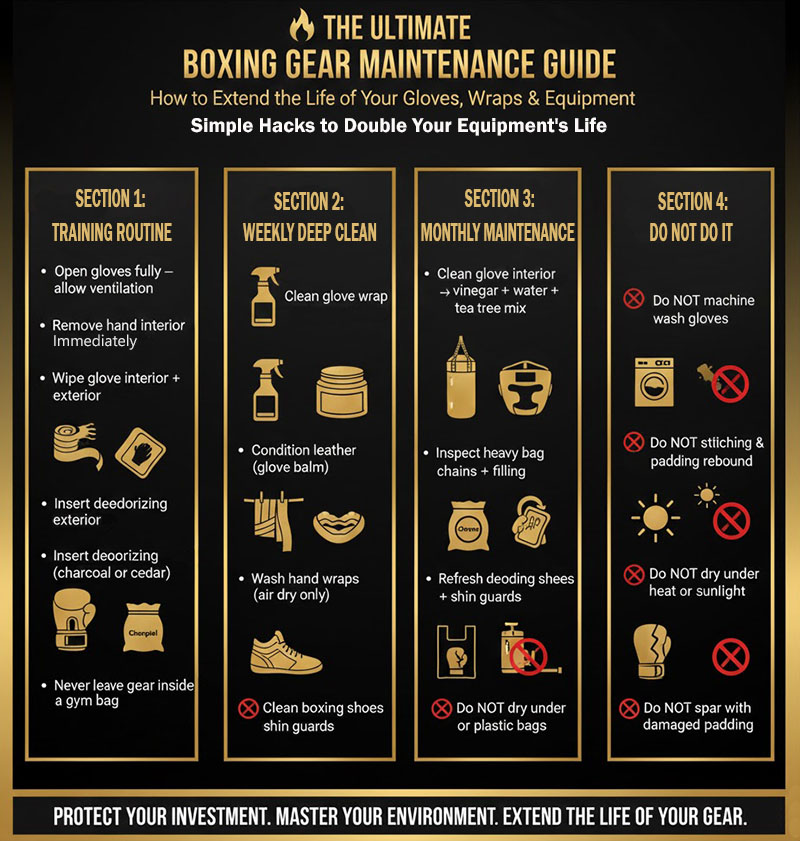
Boxing Gear Maintenance & How to Increase Durability The Fighter’s Guide to Gear Care & Simple Hacks to Double Your Equipment’s Life Let’s discuss how to enhance the durability of boxing gear and address a common issue in universal boxing gyms. You walk in, ready to train, and that smell hits you. It’s not just sweat; it’s the sour, funky odour of neglected gear. You see gloves with split seams, wraps that could stand up on their own, and bags with peeling skin. It’s demoralizing. Worse, it’s expensive. That $100 pair of gloves you bought six months ago is already falling apart. But what if I told you there’s a simple secret to making your gear last twice as long, perform better, and always smell fresh? It doesn’t require fancy products or a PhD in chemistry. It just requires a little understanding and a few minutes of care. Think of your gloves, wraps, and bag not as disposable items, but as loyal training partners. You wouldn’t let a partner sit in a puddle of sweat, would you? Caring for your boxing equipment is an extension of your training discipline. It saves you money, protects your investment, and frankly, shows respect for your craft. Let’s dive into the how and why. Your First Line of Defense – Conquering the Moisture Menace Every maintenance problem starts with one villain: moisture. When you train, your gear absorbs a cocktail of sweat, which is mostly water, salt, and bacteria. If left trapped, this mixture doesn’t just smell bad—it actively works to break down materials. Salt can degrade leather and stitching over time, while bacteria feast on the organic matter in your sweat and dead skin cells, causing odors and degrading fabrics from the inside out. The single most important principle in boxing gear maintenance is this: Airflow is everything. Your gear needs to breathe and dry completely between uses. Trapping moist gloves in a dark, airless gym bag is like creating a petri dish for destruction. The goal after every session is to move your gear from a state of dampness to a state of dryness as quickly and thoroughly as possible. The Glove Clinic – Preserving Your Most Important Tools Your gloves are your most personal and expensive piece of kit. Treat them right. The Daily Ritual (Immediate Post-Workout): As soon as you finish your last round, take off your gloves and hand wraps. Using a clean, dry cloth or a disinfectant wipe designed for sports equipment, quickly wipe down the interior lining. Focus on the finger stalls and the palm area. Then, open the Velcro wide and place them in a well-ventilated area—not on a heater, but near a fan or in a room with good air circulation. Never, ever ball them up or zip them away wet. The Deep Clean (Weekly or Bi-Weekly): For a more thorough clean, create a simple solution of 50% water and 50% white vinegar or use a specialized sports gear spray. Lightly mist the interior lining (avoid soaking the leather or synthetic exterior) and wipe it out with a clean microfiber cloth. The vinegar is a natural disinfectant and odor neutralizer. For the exterior, a damp cloth with a tiny drop of mild soap is sufficient. Always air dry completely afterwards. The Drying Doctrine: This is the game-changer. Invest in a simple glove dryer or deodorizer. These are small, electric devices you slip inside your gloves after training. They blow room-temperature air, circulating it to dry the core of the padding where moisture hides. No electricity? Use natural desiccants! Crumpled newspaper or commercial cedar shoe inserts are fantastic for absorbing moisture. Never use direct heat like a hair dryer or radiator, as it will bake and crack the leather and break down the foam padding. Storage Solutions: Once completely dry, store your boxing gloves with the cuff open. You can place them on a shelf or in a mesh or canvas gear bag that allows for air circulation. Avoid plastic bags or airtight containers at all costs. Hand Wrap Rehab – Keeping Your Wrist Guards Fresh Your hand wraps are the barrier between your sweat and your glove’s lining. They need the most frequent washing. Ideally, you should wash them after every use. It sounds like a lot, but it’s simple. The safest method is to hand-wash them in cold water with a small amount of mild detergent or sports wash. Gently scrub, rinse thoroughly, and then lay them flat or hang them to air dry. If you use a washing machine (and many wraps can handle it), always use a cold, gentle cycle and place them inside a mesh lingerie bag to prevent them from becoming a tangled nightmare. Tumble drying on low heat is sometimes okay, but air drying is always the gentlest option and preserves the elasticity longest. Heavy Bag TLC – Maintaining Your Training Anchor Your heavy bag endures a beating, but it also needs occasional care. Every few weeks, wipe down the surface with a damp cloth to remove dust, chalk, and sweat splatter. This keeps the material from drying out and cracking prematurely. Safety check! Regularly inspect the hardware. Look at the swivel, chains, and straps for signs of rust, fraying, or excessive wear. A failing swivel or strap is a serious safety hazard. Tighten any loose bolts or carabiners. If you have a hanging bag, give it a quarter-turn every month or so. This rotates the wear pattern, preventing flat spots and ensuring the bag wears evenly, extending its service life for years of hard training. Proactive Protection – Habits That Prevent Damage The best maintenance is preventative. Always wear clean hand wraps. They are your glove’s first line of defence, absorbing the brunt of the moisture and oils from your skin. If you do multiple types of training, consider having different pairs of gloves—a sturdy pair for heavy bag work and a softer, cleaner pair dedicated to sparring. This distributes the wear and tear. Finally, be patient with the new gear. Allow gloves to “break in” naturally over a few sessions. Don’t try to soften them
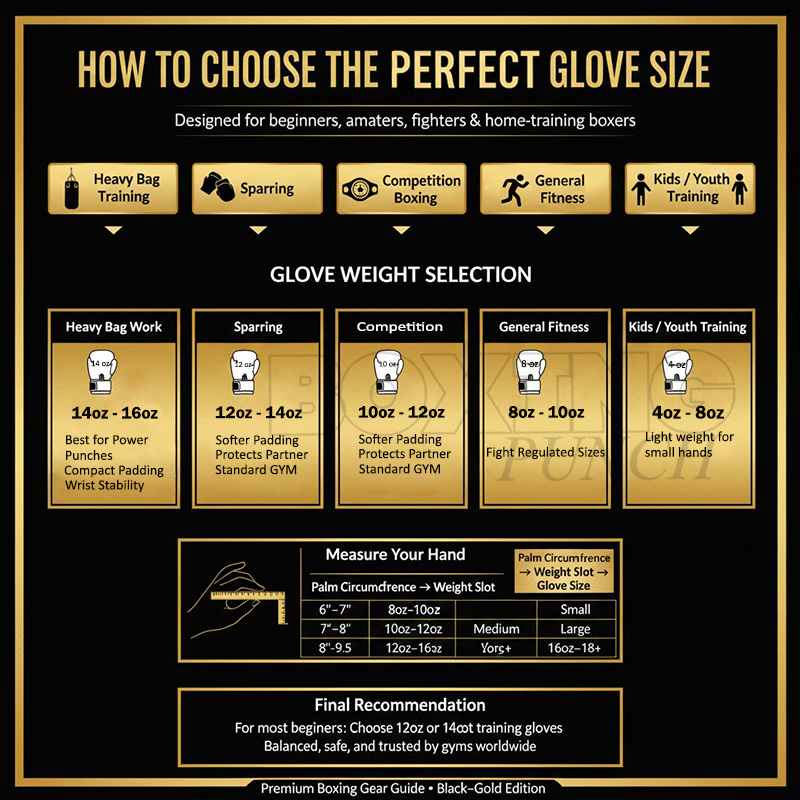
How to Choose the Perfect Boxing Glove Size Size Guide Choosing the perfect boxing glove size feels simple until you actually try to do it. Every new boxer hits the same wall—you put on one pair, and it feels too tight, another pair feels too loose, and suddenly the numbers printed on the glove (8oz, 10oz, 14oz, 16oz) mean absolutely nothing. Mostly, beginners are seen walking into a gym with gloves that are two sizes too small, with their knuckles jammed against the padding, or oversized gloves that feel like pillows strapped to their wrists. The truth is: your glove size determines your safety, comfort, technique, and long-term progress. It’s not just about buying “boxing gloves”; it’s about choosing your boxing gloves. This guide will walk you through everything that—how glove ounces work, how to measure your hand, how training style affects glove choice, the difference between men’s, women’s, and youth sizing, and how to choose the right pair, whether you’re hitting the heavy bag at home or sparring in a real gym. By the end, you’ll know exactly what size you need and why. Understanding Boxing Glove Sizes What Ounces Really Mean Boxing gloves aren’t sized like regular clothing. Instead, they’re measured in ounces (oz), and those ounces reflect the weight of the glove—not the weight of your hand. The higher the ounce, the more padding the glove contains. More padding means more protection for your hands and your training partner, which is why sparring gloves are heavier than bag gloves. For example, an 8-oz glove is compact, light, and often used for speed or competition. A 16oz glove, on the other hand, is thicker, softer, and more protective—ideal for sparring. Glove weight also affects wrist stability, and that’s why heavier gloves often offer better wrist support, especially in brands known for their padding structure. Understanding these differences helps you avoid the biggest mistake beginners make: choosing gloves based on weight alone without considering training purpose. How to Measure Your Hand for Boxing Gloves The Accurate Method Now, let’s talk about your hand. Most people guess their glove size without ever measuring anything, which usually leads to discomfort or long-term wrist strain. The right way to size boxing gloves starts with knowing your hand circumference. Wrap a measuring tape around the widest part of your knuckles—excluding the thumb. That number gives you a baseline for glove fit. If you’re using hand wraps—which you absolutely should—your glove size often increases slightly. Wraps add thickness, especially around the knuckles and wrist, so gloves that fit “just right” without wraps may suddenly feel tight once you start training properly. Your goal is a snug glove that still allows a full fist, proper thumb alignment, and secure wrist closure. Boxing Glove Size Chart for Men, Women & Youth Sizing isn’t universal across brands, but this chart gives a reliable starting point. If you’re hitting the heavy bag, doing cardio boxing, or sparring, your glove size will shift slightly. Here’s how sizes generally break down across weight ranges: 8oz gloves are mainly for youth fighters or adults with very small hands who are focused on speed or competition-style striking. 10oz gloves work well for bag work when you want more power transfer and a tighter glove silhouette. 12oz gloves are the “fitness boxing” favorite because they’re versatile for home training and cardio sessions. 14oz gloves are considered the all-purpose training glove for most adults. 16oz gloves remain the gold standard for sparring because of their high-density padding and increased knuckle protection. Women typically fall within the 12-oz–14-oz range, depending on hand size. Youth boxers often use 4oz–8oz gloves depending on age and weight. Simple Glove Size Comparison Chart This table helps beginners instantly understand which glove size matches their weight, training style, and experience level. Your Weight Bag Work Pad Work Sparring General Training Under 120 lbs 8oz – 10oz 10oz 14oz 12oz 120–150 lbs 10oz – 12oz 12oz 16oz 12oz – 14oz 150–180 lbs 12oz 12oz – 14oz 16oz 14oz 180–210 lbs 12oz – 14oz 14oz 16oz – 18oz 14oz 210+ lbs 14oz 14oz – 16oz 18oz 16oz Advanced Comparison By Skill Level & Gender User Recommended Size Reason Women beginners 12oz Balanced padding + comfort Women sparring 14oz – 16oz Safer for partner work Men beginners 12oz – 14oz Ideal for home training Men sparring 16oz Universal gym requirement Kids ages 5–10 4oz – 6oz Small hand compartment Teens 8oz – 10oz Transition sizing Competitors 8oz – 10oz Fight-weight gloves Choosing the Right Glove Size Based on Training Type This is where glove sizing really becomes personalized. Different training styles demand different glove weights. If you’re focusing on heavy bag work, you’ll want a glove that lets you feel the contact while protecting your knuckles. That’s why 10oz or 12oz gloves are often called the “best boxing gloves for heavy bag work.” They allow speed while maintaining structure. If you’re sparring, the priority shifts toward safety. Sparring requires more padding, especially over the striking surface. That’s why 16oz gloves are the universal sparring standard across nearly all boxing gyms. Home training sits somewhere in between. If you’re mixing bag work, cardio punching, and technique drills, a 12oz or 14oz glove may be the most comfortable choice. Muay Thai and MMA crossover styles use gloves that are more flexible at the wrist, so sizing also depends on mobility needs. Some people prefer 14oz Thai-style gloves because of their softer feel and wider hand compartments. Glove Size (oz) Primary Purpose Typical User / Context When / Where It’s Used 6 oz – 8 oz Competition / Youth Training Youth boxers or very small adults. Professional fights (Women’s competition often 8 oz). Official bouts. Speed & impact-focused training. Not for heavy bag or sparring. 10 oz Competition / Light Bag Work Competitive boxers (lower weight classes), some women for training, or smaller-handed adults for fitness. Amateur/pro fights. Also for technical bag work (focus on speed). Rarely for sparring (requires partner consent). 12 oz All-Purpose Training (Standard) Most women and lighter/medium-weight men (under ~150 lbs). The most common first glove for
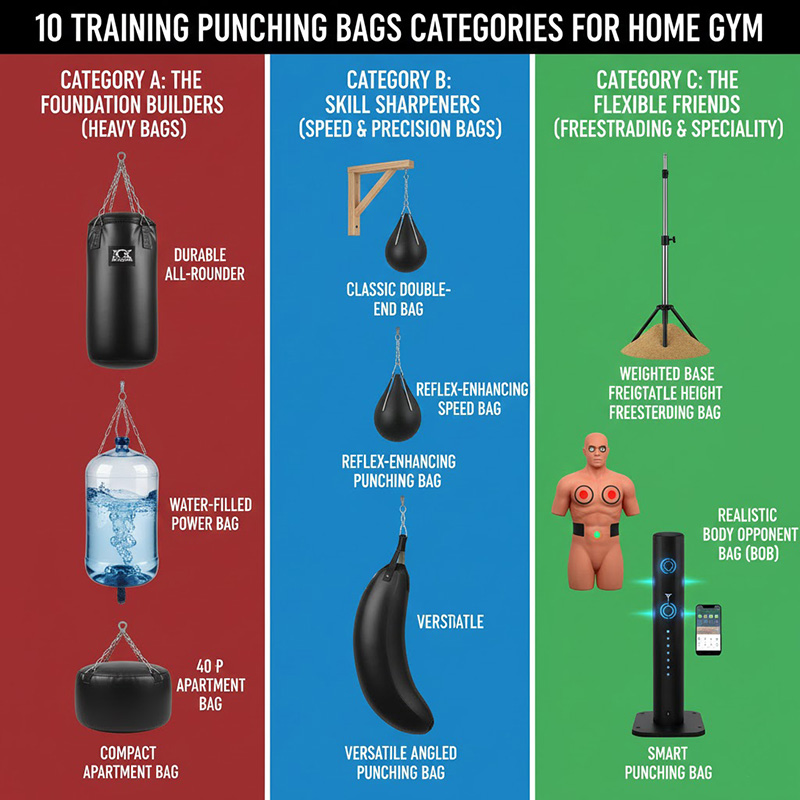
Top 10 Punching Bags for Home Training (Expert Guide 2025) Let’s be honest. You’ve pictured it. That perfect, post-work stress melts away or the morning energy boost, all just a few steps away in your own garage, spare room, or even living room corner. No commute, no crowded gym, just you, your goals, and the rhythmic thud of progress. The heart of this home fitness dream? Often, it’s a trusty punching bag. But then you start looking, and the dream hits a wall of confusion. Leather or a synthetic? Heavy bag or freestanding? How do you even hang the thing? It feels less like choosing equipment and more like decoding a secret language. That’s where this guide comes in. I was hoping you could think of me as your experienced corner coach, here to cut through the noise. We won’t just list bags; we’ll match you with the perfect training partner for your story, your space, and your ambitions. Let’s find the bag that makes you excited to train. If you’ve ever thrown a punch in your living room—just to shake off stress or test your jab—you already understand why punching bags have become one of the fastest-growing home-fitness essentials of 2025. They don’t require much space, they’re incredibly effective for cardio and strength, and they provide a rush you can’t get from dumbbells or treadmills. And when you pair the right punching bag with the right boxing gloves, your home transforms into a personal fight camp. But choosing the best punching bag for home training isn’t as simple as clicking “add to cart.” Every bag reacts differently, trains you differently, and requires a specific setup. Whether you’re a beginner searching for a dependable heavy bag or someone who already owns multiple pairs of boxing gloves—Winning, Grant, Cleto Reyes, Hayabusa, Venum, Everlast, RDX, and more—this guide will walk you through every detail with the ease of a coach explaining things in your corner. So let’s step into the ring and explore the punching bags that actually deserve a place in your home. Before the First Punch – Know Your Corner Throwing a credit card at the first bag you see is a surefire way to end up with an expensive clothes hanger. Successful home gyms are built on a little planning. Ask yourself these three questions: First, What’s Your “Why”?Are you looking to build knockout power and raw strength? Then a dense, heavy bag is your soulmate. Is your goal sweat-dripping, heart-pounding cardio and endurance? A lighter, faster bag will be your dance partner. Maybe you’re a martial artist focused on sharpening technique, timing, and precision? That calls for a specialized tool. Or perhaps, above all, you need a reliable, physical outlet for stress. Honestly, any bag will help with that, but choosing the right one makes it feel better. Second, Face Your Space Reality. Be brutally honest. Do you have solid ceiling joists in a basement for a hanging bag, or are you in a rental with questionable walls? Do you need to roll your bag into a closet after a session? Measuring your floor space and ceiling height isn’t glamorous, but it’s the difference between a harmonious gym and a permanent obstacle course. Also, consider your neighbors or family downstairs—some bags and mounts are kinder than others. Third, Gear Up Your Weapons. This is non-negotiable. Your hands are complex, delicate tools. Throwing punches without protection is a shortcut to sprains, fractures, and early arthritis. Before you even touch your new bag, invest in a quality pair of hand wraps to stabilize your wrists and knuckles, and a good set of training gloves. Your future self will thank you. Understanding the Different Types of Punching Bags Before You Buy One Not all bags are created equal. Each type is a specialist, designed for a particular aspect of your training. Choosing a punching bag without understanding the categories is like buying the best boxing gloves for sparring and using them on a 150-lb heavy bag—you’ll ruin them in no time. Every bag has its purpose, personality, and training focus. Not all bags are created equal. Each type is a specialist, designed for a particular aspect of your training. Choosing a punching bag without understanding the categories is like buying the best boxing gloves for sparring and using them on a 150-lb heavy bag—you’ll ruin them in no time. Every bag has its purpose, personality, and training focus. Heavy Bags (Classic Hanging Bags) This is the iconic gym staple. It’s the heavy, cylindrical bag you imagine when you think of boxing training. Filled with dense materials like fabric or sand, it’s designed to absorb powerful punches and kicks, building strength, stamina, and fundamental technique. It’s your go-to for practicing combos and learning how to truly sit down on your punches. When people imagine a punching bag, this is usually what comes to mind. A heavy bag hangs from the ceiling, giving you real resistance for power shots, uppercuts (if long enough), and Muay Thai knees. These bags are perfect if you’re training with 12 oz, 14 oz, or 16 oz boxing gloves—especially if you use brands known for durability like Title Boxing, Everlast, Hayabusa, or Rival Boxing Gloves. Most heavy bags weigh between 70–150 lbs. Beginners tend to love the 70–100 lb range, while advanced strikers and conditioned fighters use 120–150 lb bags for greater resistance. Free-Standing Punching Bags No installation needed. These bags have a heavy, often water- or sand-filled base with a flexible shaft and a bag on top. They’re fantastic for renters, multi-use rooms, or anyone who hates drilling into walls. The trade-off? They can “walk” across the floor with powerful strikes and have a different rebound feel than a hanging bag. If drilling holes in the ceiling isn’t an option, a free-standing punching bag becomes your best friend. These bags have a weighted base (sand or water), making them ideal for apartments or garages. They’re also quieter than hanging bags, which matters if your downstairs neighbors already think