
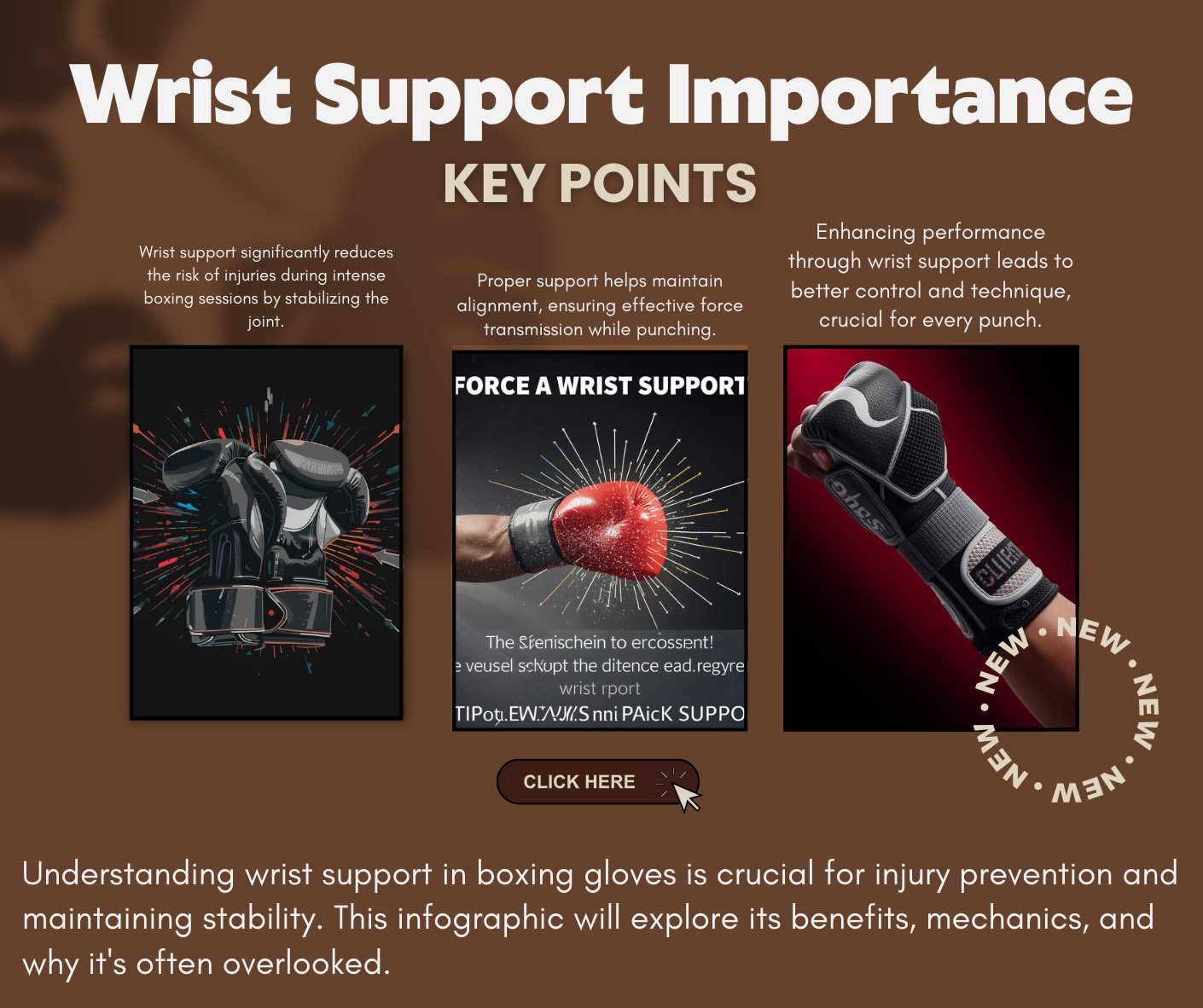
Why Wrist Support Is Essential in Boxing Gloves
Why Wrist Support Is Essential in Boxing Gloves Introduction – The Hidden Hero of Boxing Gloves Most people buy boxing...
“🛒 Sale Live: Up to 30% OFF on boxing gear!” Dismiss
Skip to contentA stable wrist acts as a solid nozzle on a high-pressure hose, directing all the force from your legs and core straight into your target. If your wrist bends on impact, that energy “leaks” back into your joint instead of being delivered, robbing you of knockout power and inviting injury. The fix is a combination of proper hand-wrapping technique, smart glove choice, and dedicated wrist strengthening.
I remember the first time I truly felt it. I’d spent months building my legs, my core, my rotation. I threw a cross at the heavy bag with everything I had. I felt the drive from my back foot, the whip of my hip, the surge of power… and then, a faint but unmistakable give.
It wasn’t in the bag. It was in my wrist. A microsecond of collapse, followed by a dull ache that lingered. The bag swung, but it didn’t jump. The sound was a muffled thud, not the sharp crack I was chasing. In that moment, I realized I hadn’t just felt a twinge of pain—I’d felt my knockout power leaking out of my body.
You can have the strongest legs, the fastest hips, and the most explosive shoulders in the world. But if the final link in the chain—your wrist—is weak, you’re pouring your championship-level power into a broken pipe. Let’s fix that leak for good.
Most fighters blame weak arms when their punches lack impact. The real problem is usually the wrist.
When the wrist bends on contact, force leaks out. Instead of transferring energy forward, your punch collapses inward. Proper wrist support keeps the fist aligned with the forearm, allowing rotational torque to pass cleanly through the punch.
Wrist stability also reduces micro-adjustments in the nervous system. When your brain trusts your joints, it allows you to punch harder without hesitation.
Think of your kinetic chain—that beautiful sequence from feet to hips to shoulder to fist—as a high-pressure fire hose. Your legs are the pump, your core is the engine, and your shoulder is the valve. All that pressurized water (your power) is surging forward, ready to blast.
Your wrist? It’s the nozzle. If that nozzle is solid, locked on target, all that force shoots out in a concentrated, devastating stream. But if the nozzle is kinked, flimsy, or pointed slightly off? The water sprays everywhere uselessly. The pressure is lost. That’s your energy leak.
This isn’t just a metaphor; it’s basic physics (Newton’s Third Law). When your fist strikes an object, that object strikes back with equal force. The purpose of your entire body’s structure is to withstand that reaction force and deliver it through the target.
Here’s the critical part: A stable wrist transmits force. A collapsing wrist absorbs it.
When your wrist is locked in perfect wrist alignment for boxing power, it creates a rigid, straight line from your forearm to your knuckles. This allows the shockwave of energy from your body to travel unimpeded. You deliver what physicists call your Effective Mass—essentially, your entire body weight behind the punch.
But if there’s any bend—even a few degrees—on impact, that reaction force gets diverted. It’s spent on deforming your joint, stretching your ligaments, and compressing your carpal and metacarpal bones in ways they shouldn’t. The energy doesn’t go into your opponent; it reverberates back into your own anatomy. That’s power lost due to poor joint stability.
This leak isn’t silent. It has symptoms:
Your mission is to turn your wrist from a shock absorber into a steel beam.
Before your bones and tendons get strong enough on their own, you use gear to build an external fortress. This is a two-part system: the wrap (the foundation) and the glove (the exoskeleton).
Wrapping isn’t about comfort. It’s about creating a single, unified structure. You’re not wrapping a hand; you’re casting a weapon.
The goal is maximum stability. The most effective technique is often called The “Cast” Method. You’re using the wrap to lock your wrist in a neutral, straight position—the optimal alignment for power. Every pass of the wrap around your wrist and through your thumb web should have intention.
Pro-Tip: Many elite fighters prefer Mexican-style hand wraps. They have a stretchy, elastic quality that allows for a tighter, more compact, and supportive wrap compared to traditional standard cotton wraps. This creates incredible internal density, fusing your hand into a solid block. Searching for “Canelo wrap style” will give you a masterclass in this approach for heavy hitters.
The glove is your final layer of architecture. Here’s the crucial point: Wrist support is about the closure system, not the weight. A poorly designed 16-oz glove can offer less support than a well-designed 10-oz glove.
The eternal debate: Lace-up vs. Velcro gloves for wrist support.
This is where specific gear shines. Brands have innovated wildly:
When discussing the pinnacle of protection, conversations often turn to brands like Winning vs. Grant. Winning is legendary for its pillow-like shock dispersion and its unique, supportive thumb alignment and wrist structure, proving that comfort and stability aren’t mutually exclusive.
Gear is a brilliant tool, but your body must be the primary foundation. You need to build the biological version of that fortress. This is where wrist stability exercises for boxing move from niche to essential.
Prehab & Rehab
Rice Bucket Training
It might look old-school, but rice bucket training has gone viral for a reason. It’s one of the best methods for building wrist tendon strength and improving proprioception—your brain’s sense of where your joint is in space.
Sink your hand into a bucket of uncooked rice and perform slow, deliberate movements: wrist extensions, flexions, rotations, and gripping motions. The rice provides uniform, gentle resistance in every direction, strengthening all the tiny stabilizer muscles and tendons that a dumbbell curl misses. It’s prehab to prevent injury and rehab to heal it.
Functional Strength
Beyond the Bucket
Signs You’re Losing Power (The “Energy Leak” Checklist)
How do you know if you leak? Watch and listen for these tells:
Q: Does wrist taping increase punching power?
A: Directly, no. Athletic tape doesn’t add energy. But by Enhancing joint stability and proprioception, it allows you to punch with more confidence and transmit force more efficiently. This can result in more power being delivered because you’re not subconsciously holding back to protect the joint.
Q: Why do my wrists hurt when punching hard?
A: This is the classic signal of an energy leak and poor force transmission. The impact force that should go into the target is being absorbed by your wrist structures—ligaments, tendons, and the small carpal bones. It’s a clear sign you need to improve your wrapping technique, reassess your glove’s wrist support, and start a dedicated strengthening routine.
Q: How do I prevent a Boxer’s Fracture?
A: A Boxer’s Fracture is a break of the 5th metacarpal (pinky knuckle). Prevention is a triad: 1) Proper Wrapping: Use the “cast” method to compact and support the metacarpals. 2) Correct Technique: Hit with your first two knuckles (index and middle), which are better aligned with your wrist. 3) Strength Training: Towel wrings and rice bucket drills build the supportive musculature.
Q: Do heavier gloves provide better wrist support?
A: Not necessarily. While heavier gloves have more padding, wrist support comes from the cuff design and closure system. A 14oz glove with a superior wrist-lock system (like a good lace-up or advanced Velcro design) will always offer better support than a 16oz glove with a floppy, single-strap cuff. Weight is for sparring and conditioning; design is for support.
From Leak to Lock
Chasing punching power is a journey of connecting links. We obsess over footwork, hip rotation, and shoulder snap—and rightfully so. But the journey doesn’t end at the shoulder. It travels down that last crucial inch to your wrist.
Wrist support is the final seal on the system. It’s the difference between a circuit that sparks and one that delivers a full, devastating current. By understanding the physics of the energy leak, mastering the art of the wrap, choosing your gloves for wrist support intelligently, and committing to iron wrist training, you do more than prevent injury.
You complete the circuit. You lock in your power. And you transform that disappointing thud into the unmistakable, authority-filled crack of a punch that arrives with everything you intended to send.
Keep the Momentum Going: Don’t stop your training here. If you found this helpful, you’ll gain a massive edge by reading our guide on “How to Improve Punching Power in 30 Days” or learning about “Why Wrist Support Is Essential in Boxing Gloves”.
Why Wrist Support Is Essential in Boxing Gloves Introduction – The Hidden Hero of Boxing Gloves Most people buy boxing...
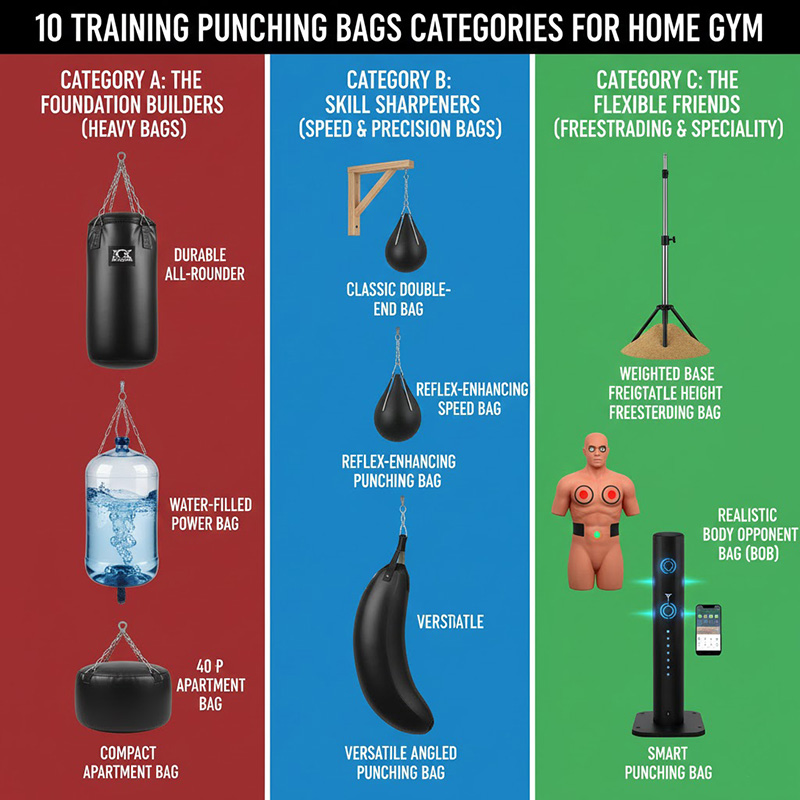
Transform Your Home, Transform Your Fitness Level Top 10 Punching Bags for Home Training (Expert Guide 2025) Let's be honest....
Plyometrics for Boxing Science vs Myths Plyometrics aren’t about jumping higher — they’re about firing muscles faster. Boxing relies heavily...